“Your information on Risk Management is a totally new way of thinking for me. Everything comes back to health.” Cindee – Boone, N.C.
“I wanted to develop personally during this class. Now I know how to also help my staff develop professionally as well.” John- Kennesaw, GA.
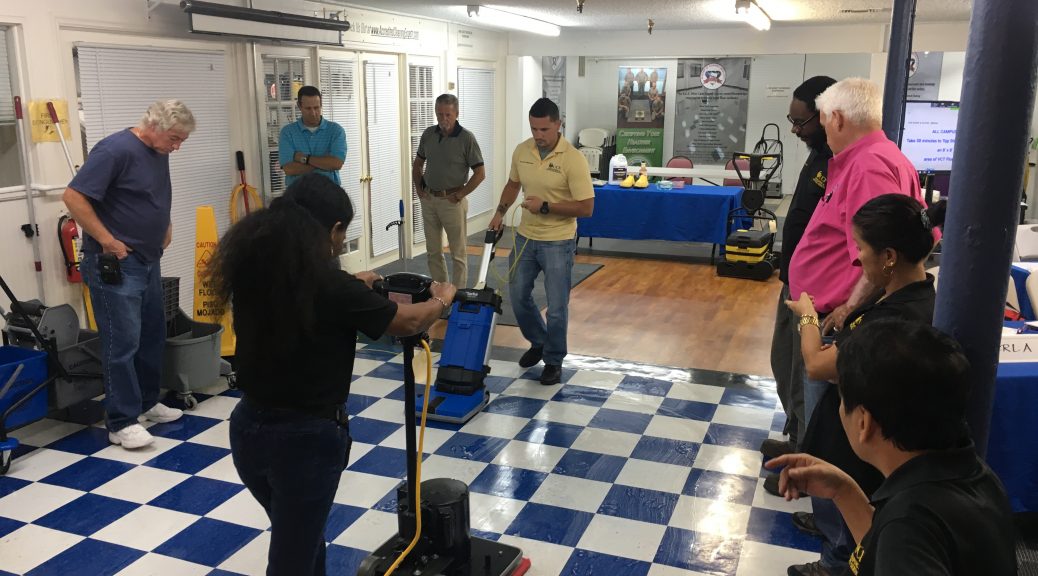
Whether you are new to the industry or a veteran, this ISSA/CMI Masters certification class is guaranteed to give you up to date techniques and technology that you can use within your business.
Be ready to change your mindset!
Have you found yourself in charge of a department you know nothing about?
Just moved into a position where the staff knows more than you?
Are you now inspecting work and have no idea as to the “how’s” and “why’s”?
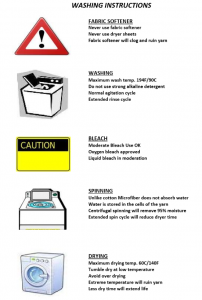
If the towel/wiper/pad becomes too dirty, it will also begin to “streak”. It is then time to wash the towel. This is easily done by just throwing the towel, or any other microfiber cleaning product, into any washing machine and laundering with any soap or detergent you prefer.
A word of caution here; experience tells me you should be careful of the additives in our detergent as they tend to build up in the microfiber, reducing its’ ability to perform as intended. The other restriction in the wash cycle is to NEVER use any type of FABRIC SOFTENER.
The towel will treat the fabric softener as if it was dirt. It will try to store the tiny particles of the softener in the towel fibers and may cause the towel to be less effective. The use of any POLISHES will result in the same issues.
Microfiber does not MOVE the dirt or dust. It actually tries to trap it, and this means a microfiber product will “fill up” periodically. This dirt and dust is released in water and soap. Soap helps release the greasy part of the build-up. If the fiber is being used with water, it must be rinsed and wrung out periodically for best performance.
Remember, the microfiber is trying to trap and remove dirt and dust, and it should not be used to mop a whole floor or clean a whole room. The skill comes with knowing when to change out or rinse out the microfiber tool.
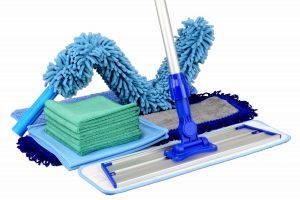
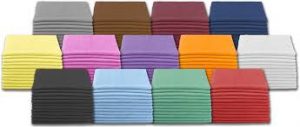
Microfiber is available in several different forms. The most common forms are the “Terry Style” and the “Suede Style.” The terry style is best suited for all general cleaning purposes, both domestic and industrial.
Suede works best in any “polishing” application, such as eye glasses, sun-glasses (except transitional A/R), all optics and lenses, CD’s, computer screens, TV screens, jewelry, coins, leather, and even as a replacement for a chamois to dry off your car.
Both of these styles can be used wet or dry, without soap or chemicals (chemicals CAN be used with microfiber, but usually they are not needed!)
Unlike ordinary cleaning towels that only move or push the dirt and dust from one point to another, microfiber actually “scrapes” the dirt or stain from the surface, and then stores the dirt particles in the towel, until it is washed.
Most of the time, it is best to use the suede towel dry, however, it will never harm the towel if you want to wet it. With both of these towel styles, when using wet, it is very important to always wring the towel as dry as possible. If a microfiber towel is dripping water, it is too wet and will leave streaks on the surface you are cleaning.
The technology was first developed commercially in Japan in the mid to late 1960’s for synthetic suede fabrics. Staple fibers were spun from two polymers, a polyester and polyamide of 0.1 denier or less.
If the microfiber is not split the cloth, pad or mop will tend not to be very effective. How many times a single strand of 1 denier microfiber is split, will make a tremendous difference in the performance of the tool.
Be advised there are 4, 8, 16 split and this will also have bearing on the initial investment as well. It is during this process the percentage blend of polyester and polyamide will show up. Always look for a processed microfiber wiper or pad to improve performance.
Downsizing soap dispenser shots might save stock, but it could compromise handwashing practices
To save money and maximize budget dollars, cleaning departments are looking to reduce usage and extend inventory wherever possible — particularly in restrooms, where commodities such as paper and soap need constant replenishing. Altering the size of paper towel output from dispensers is common practice in many facilities. Similarly, downsizing a shot of soap is becoming more prevalent as a means to stretch stock. But are these cost-cutting measures achieving the desired outcome, or are they in fact derailing proper handwashing practices?
“It’s difficult for me to defend cutting back on soap,” says Jim Mann, executive director and founder of The Handwashing Leadership Forum, Libertyville, Illinois. “We already know that people aren’t washing their hands as often as they should, so right away we’re compromising on a standard that isn’t effective. We should be effective first and then efficient.”
Saul Strain, vice president of ABC Sales & Services, headquartered in St. Thomas, Virgin Islands, agrees and dissuades facilities from reducing soap shot sizes further than what is recommended by the manufacturer.
“I think cleaning managers are trying to maximize how many uses are in a box or a bag of foam soap, and I don’t think they’re wasting a drop of it,” he says. “Going down further from what is recommended might be creating an unhealthy environment. Even though building occupants are washing their hands, they’re being counterproductive.”
Furthermore, one can argue that reducing the size of a single shot to save on soap may in fact have the opposite effect.
“If someone dispenses a little bit of soap, and they feel it’s not enough to wash their hands, they might double-pump or wave their hand under the dispenser a second time,” notes Keith Schneringer, director of channel marketing and sustainability, Waxie Sanitary Supply, San Diego. “So let’s say you have 0.7 ml as the default setting and you go down to 0.4 ml, but people are pumping twice. Now you’re using 0.8 ml, and some people don’t stop at two pumps.”
Restroom users often activate the dispenser multiple times out of habit, regardless of how much soap is dispensed in a single shot.
“There’s a bit of psychology to this,” Mann admits. “A lot of people are multiple pushers. They want enough to get the job done as fast as they can.”
Mann also cautions facilities against limiting the amount of soap dispensed from a dispenser, or the amount of water dispensed from a faucet, because controlled dispensing mechanisms can act as a deterrent to handwashing.
“If you’ve got someone else making the decision for you, and you want more soap and you don’t have it, it can be frustrating,” he says. “The disincentives for washing hands are something to monitor very closely.”
The survival of any business depends on Customers. So what is the best way to attract customers? Some would say, lowering the price of your products is the correct answer; however, instead of gaining customers, this can actually cause you to lose them by either making your company look cheap creating a price war with your competitors. In a price war, there is no winners because, potential revenue is lost by all companies involved.
A friend of mine had this exact experience. He had a car washing business that was thriving in the urban part of town, when he was charging $40 for a full detail and wax. Because of his success, he considered expanding the business into a wealthier part of town. He researched what products his competitors were using and the prices they were charging, and he found they were charging close to $100 for the same services, using the same products. Expecting great success, he expanded and continued charging $40 for his services. To his surprise he wasn’t getting much business, which didn’t make sense to him because he was charging less than half of his competitors price. He decided to increase his price to $110 in this part of town, which resulted in him getting more business than he could handle.
Increasing business by raising prices may not make sense unless you understand the idea of perception. No matter the price of your product, as long as your customers perceive that its worth the price, they will pay it. In the previous example to the wealthier part of town a $40 detail and wax seemed cheap and therefore was perceived to be an inferior service, even though there was no difference between the two.
“I Am Rich” App
The next example involves the most expensive app ever created for the I Phone called “I Am Rich”. This app was just a screen with a black background and a red gem in the center (see the picture) and sold for $999.99, but did nothing! (Even more amazingly this app was sold 8 times before being pulled, because someone clicked to purchase it to see what would happen and didn’t know his wife enabled one click purchase(or so he says)).
Why were people willing to pay $999.99 for an app that did nothing? It leads back to the customers’ perception and which customer group you to attract. This product, for example, was marketed to people who just wanted to show off that they could spend a thousand dollars and not care.
As shown with these examples, cutting prices isn’t the best way to promote your products. Instead, find a way to create increased value of the product for your customers to warrant the current price charged. A great example of adding value to a product can be seen through the debate between Apple and Samsung. Although Samsung has a clearly superior operating system and phone specs, I Phone sales are higher than Samsung in the U.S. even though both companies charge fairly the same amount. I Phone has created a perception of higher value with the ineradicable attribute of their “Eco System”, which is the way customers of Apple can connect and sync their data across all their Apple products. This perceived value in Apple products enables them to remain competitive in the U.S. despite having an inferior device in most other ways.
To gain their trust and earn their repeat business, go the extra mile to give customers a positive experience during and after their purchase. It is much easier and less expensive to keep a customer than gain a new one.
Another year has gone by and its now the year 2015. Even though we don’t have practical flying cars, we have seen some booming products in the cleaning industry during 2014, and anticipate huge advances coming in this new year.
A pure acrylic high powered floor finish that has an outstanding scratch and abrasion resistance , and high durability. The nano-additive helps significantly with the products leveling properties, making it easier to layer the finish uniformly.
Z-310 max:
This was another big hit from 2014; being a high powered, ultra concentrated stripper that can take off up to 8 coats of finish at a time. This stripper is extremely portable by requiring only 1 quart of stripper per 5 gallons of water, which also helps maintain a low odor.
Following 2014’s big sales of auto vacuums, Kaivac has developed the first battery powered Auto Vacuum. The OmniFlex is a high powered Auto Vacuum that is said to “rival the performance of auto scrubbers at a fraction of the cost. With these small and non-complex systems high maintenance costs are a thing of the past. Unlike auto-scrubbers, there is little that can go wrong in these new systems, and if it does, it is easy to troubleshoot and repair.
This disinfectant has become the leading product for kill time of C-diff with a remarkable 2 mins. Perisept doesn’t contain any bleach so it is safer to use on surfaces, and has a dilution rate of 1:32 making it more affordable to use as a daily cleaner. This product is only available in Navigator Proprietary Dilution. This dilution station comes in a 4 spot, 1 spot and portable dispensing units to minimize training needed to dilute this product.
Intellibot, Hydro 17:
Intellibot has been working on their newest and greatest robot yet. The Hydro bot is a 17 inch small scrubber completely automated and designed to work in areas that don’t need or don’t have the space for their larger models. This little robot can clean approximately 6400 sq ft per hour, while 100% automated, making it possible to drop labor costs dramatically within a company. This new addition to the intellibot line is exoected to come out in the first half of 2015.
When people look at the sales of a company, most will only look at the amount of customers they service. That only equates to half of the business equation. The other half is your employees. If the employees of a company aren’t feeling appreciated or are unhappy, the production and quality will decline. The worst thing that can happen to a company isn’t an unappreciated customer, but instead an unappreciated employee. This can cause tremendous problems for a company, because unappreciated employees doesn’t equate to one mistreated customer, but possibly hundreds of dissatisfied customers.
Causes of Employee Dissatisfaction:
Communication:
There always needs to be a strong line of communication between all channels of a business. One of the hardest obstacles to overcome is when an employee is given minimal information about a project, but expected to complete it in its entirety or when a manager asks the information about a current project and gets no feedback.
Common Ideas:
Nobody is going to agree on everything that is being done in a company, but there needs to be a clear and decisive goal for a company’s objectives. This allows the employees to remain focused on expanding and developing the company. These ideas need to be communicated to each employee so they know the true purpose of the company.
Team Building:
Companies, no matter how big or small, require teamwork. Without it, a company can’t grow to its full potential. The question is, what is the best way to promote teamwork within a company? There are many different ways to promote these ideas, such as going to team building exercises that create trust between the employees, another could be holding company parties to promote friendship. The main goal is to help your employees feel like they aren’t working just for a paycheck, but to see the company flourish from the work that each employee does.
Morale:
This is the main driving force for all employees, so how do we keep high morale? Through gratification, compensation, and fun! Gratification can be as simple as telling someone they did a great job last week, or putting up an employee of the month photo each month of someone who went above and beyond. Compensation is typically in the form of pay, but it doesn’t have to be. You can give incentives to employees to motivate them to the victory. An example might be, if we meet a quota of getting 7 percent more revenue next quarter, the company will purchase an entertainment piece, such as a Flyboard or Jet-skies for company events. Through it all, the company needs to have fun. No one wants to work all day without any play. This can also be celebrating birthdays, celebrating holidays or even having gatherings on non-work days to say “thanks” to your employees and what they have done for you.
While the customers are a big part of a company, the employees are equally important. They are the oil to the motor of the corporation’s gears. They are the ones who produce the sales and retain the customers. Just like if you don’t take care of customers, if you don’t take care of your employees then your business will never succeed. So remember to communicate the ideals of your company, perform team building exercises and don’t forget to schedule time for Fun!
"The most valuable resource an operation has is an engaged employee, let that be YOU!"



 the initial investment as well. It is during this process the percentage blend of polyester and polyamide will show up. Always look for a processed microfiber wiper or pad to improve performance.