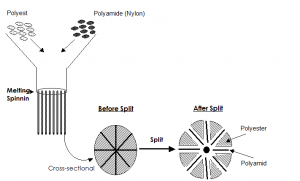
The technology was first developed commercially in Japan in the mid to late 1960’s for synthetic suede fabrics. Staple fibers were spun from two polymers, a polyester and polyamide of 0.1 denier or less.
If the microfiber is not split the cloth, pad or mop will tend not to be very effective. How many times a single strand of 1 denier microfiber is split, will make a tremendous difference in the performance of the tool.
Be advised there are 4, 8, 16 split and this will also have bearing on the initial investment as well. It is during this process the percentage blend of polyester and polyamide will show up. Always look for a processed microfiber wiper or pad to improve performance.
Now that you know a microfiber is simply a nano sized fiber, what is that nanofiber made of?
Microfiber is a man-made product combining two basic fibers, Polyester and Polyamide (a nylon by-product.)
These fibers are then “split” and formed into a blend of
80% Polyester (the scrubbing and cleaning fiber), and
20% Polyamide (the holding and quick drying fiber.)
In written form, this blend is expressed as “80/20.”
There are approximately 200,000 microfibers in one square inch of a microfiber towel. A single strand of microfiber is so small that it is almost invisible to the naked eye.
These ultra-small fibers give the material the ability to clean surfaces and remove dust and dirt without scratching. You can often detect a microfiber cloth because it clings to your skin as you rub it.
Consider the fact that one square yard of a microfiber cleaning towel, if torn apart and the fibers laid end-to-end, would reach from Miami, FL to Minneapolis, MN!

 the initial investment as well. It is during this process the percentage blend of polyester and polyamide will show up. Always look for a processed microfiber wiper or pad to improve performance.