“I would recommend this class to any new employee, mid-level and executive level managers, as it will open your eyes and mind to see how our field impact the lives of others every day.”
Pascale – Miami, FL
This event is hosted by;
Be sure to sign up early as the class size is limited.
Individuals for this class come from all areas of the United States and from around the globe. You never know who may inspire you with what they know and what you may learn from each other.
“The future is won by those creating the future…and not the ones trying to maintain the status quo.”
Instructor; David Thompson, Director of the Academy of Cleaning Excellence.
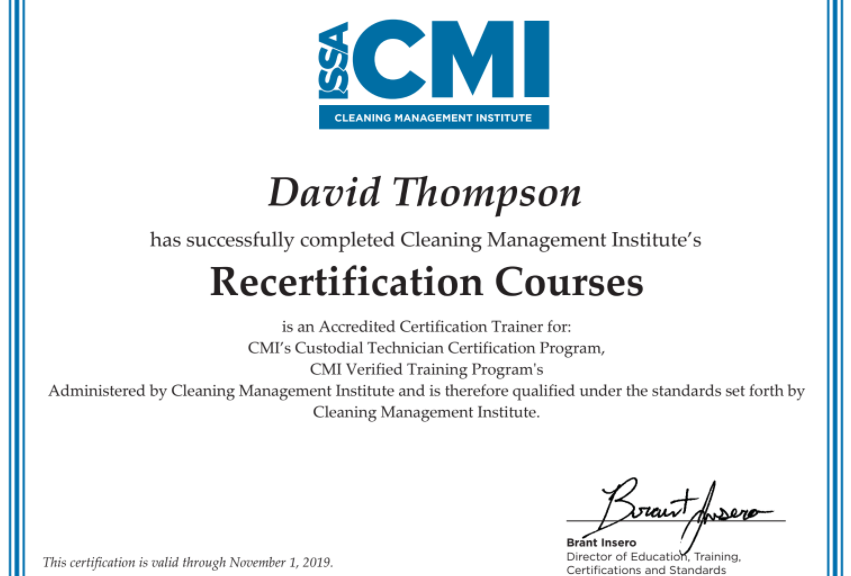
Mr. Thompson is an ISSA/CMI Accredited Certification Trainer with experiences as a K-12 custodian, Building Services Contractor (BSC), cleaning consultant and has been educating frontline service personnel for over 4 decades.
“Your information on Risk Management is a totally new way of thinking for me. Everything comes back to health.” Cindee – Boone, N.C.
“I wanted to develop personally during this class. Now I know how to also help my staff develop professionally as well.” John- Kennesaw, GA.
Whether you are new to the industry or a veteran, this ISSA/CMI Masters certification class is guaranteed to give you up to date techniques and technology that you can use within your business.
Be ready to change your mindset!
Have you found yourself in charge of a department you know nothing about?
Just moved into a position where the staff knows more than you?
Are you now inspecting work and have no idea as to the “how’s” and “why’s”?
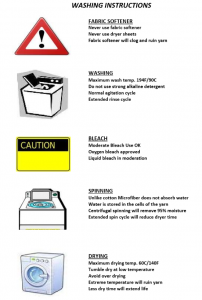
If the towel/wiper/pad becomes too dirty, it will also begin to “streak”. It is then time to wash the towel. This is easily done by just throwing the towel, or any other microfiber cleaning product, into any washing machine and laundering with any soap or detergent you prefer.
A word of caution here; experience tells me you should be careful of the additives in our detergent as they tend to build up in the microfiber, reducing its’ ability to perform as intended. The other restriction in the wash cycle is to NEVER use any type of FABRIC SOFTENER.
The towel will treat the fabric softener as if it was dirt. It will try to store the tiny particles of the softener in the towel fibers and may cause the towel to be less effective. The use of any POLISHES will result in the same issues.
Microfiber does not MOVE the dirt or dust. It actually tries to trap it, and this means a microfiber product will “fill up” periodically. This dirt and dust is released in water and soap. Soap helps release the greasy part of the build-up. If the fiber is being used with water, it must be rinsed and wrung out periodically for best performance.
Remember, the microfiber is trying to trap and remove dirt and dust, and it should not be used to mop a whole floor or clean a whole room. The skill comes with knowing when to change out or rinse out the microfiber tool.
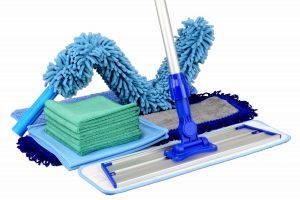
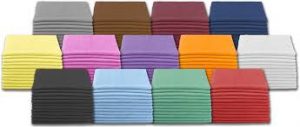
Microfiber is available in several different forms. The most common forms are the “Terry Style” and the “Suede Style.” The terry style is best suited for all general cleaning purposes, both domestic and industrial.
Suede works best in any “polishing” application, such as eye glasses, sun-glasses (except transitional A/R), all optics and lenses, CD’s, computer screens, TV screens, jewelry, coins, leather, and even as a replacement for a chamois to dry off your car.
Both of these styles can be used wet or dry, without soap or chemicals (chemicals CAN be used with microfiber, but usually they are not needed!)
Unlike ordinary cleaning towels that only move or push the dirt and dust from one point to another, microfiber actually “scrapes” the dirt or stain from the surface, and then stores the dirt particles in the towel, until it is washed.
Most of the time, it is best to use the suede towel dry, however, it will never harm the towel if you want to wet it. With both of these towel styles, when using wet, it is very important to always wring the towel as dry as possible. If a microfiber towel is dripping water, it is too wet and will leave streaks on the surface you are cleaning.
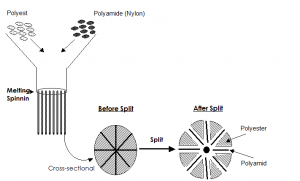
The technology was first developed commercially in Japan in the mid to late 1960’s for synthetic suede fabrics. Staple fibers were spun from two polymers, a polyester and polyamide of 0.1 denier or less.
If the microfiber is not split the cloth, pad or mop will tend not to be very effective. How many times a single strand of 1 denier microfiber is split, will make a tremendous difference in the performance of the tool.
Be advised there are 4, 8, 16 split and this will also have bearing on the initial investment as well. It is during this process the percentage blend of polyester and polyamide will show up. Always look for a processed microfiber wiper or pad to improve performance.
Now that you know a microfiber is simply a nano sized fiber, what is that nanofiber made of?
Microfiber is a man-made product combining two basic fibers, Polyester and Polyamide (a nylon by-product.)
These fibers are then “split” and formed into a blend of
80% Polyester (the scrubbing and cleaning fiber), and
20% Polyamide (the holding and quick drying fiber.)
In written form, this blend is expressed as “80/20.”
There are approximately 200,000 microfibers in one square inch of a microfiber towel. A single strand of microfiber is so small that it is almost invisible to the naked eye.
These ultra-small fibers give the material the ability to clean surfaces and remove dust and dirt without scratching. You can often detect a microfiber cloth because it clings to your skin as you rub it.
Consider the fact that one square yard of a microfiber cleaning towel, if torn apart and the fibers laid end-to-end, would reach from Miami, FL to Minneapolis, MN!
As the Director of Education here at the Academy of Cleaning Excellence, it is important for me to keep my certifications current and up to date.
In order to instruct professional development classes around the globe, I maintain my ISSA/CMI Accredited Certification Trainer status every two years.
Verified certificates from an organization, which is known in an industry, carries with it a value worthy of the workplace.
Let this be evidence that I “walk the talk” so to speak.
“The future is won by those creating the future…and not the ones trying to maintain the status quo.”
As professionals in the cleaning industry, we use water in many cleaning processes and many individuals may not realize that there are ways we can alter water to clean better.
Surfactant
pH
Oxidization
Pressure
Surfactant
The concept of “Making Water Wetter” has been an age-old idea. While not trying to be too complicated, water has a property called “Surface Tension”. Surface tension may slow down the cleaning process because the water does not wet the surface, but remains on the surface. This is why water will bead up on a smooth surface. Surfactants reduce the water tension.
Surfactants are generally soaps. Surfactants perform other important functions in cleaning, such as loosening, emulsifying (dispersing in water) and holding soil in suspension until it can be rinsed away.
pH
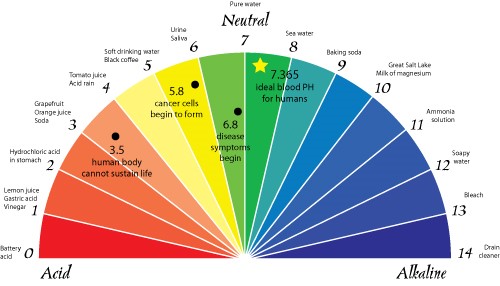
The power of Hydrogen (pH) refers the level of acidity or alkalinity of a solution. pH uses a scale of 0 to 14 to measure the pH. Water is ‘neutral’ at a 7 ph on the scale. Below 7, the solution is more of an acid. Above 7, the solution is considered an alkaline.
Strong acids and alkaline are more likely to emit volatile organic compounds (VOCs), which are yet another concern for those in the cleaning services. Cleaning experts have long argued, that prolonged exposure to VOCs is a known health hazard.
pH will always be a factor in cleaning, and like many things in life, the most concerning are the extremes that may be adopted in the cleaning program. All product labels have the pH levels identified as part of the safe handling of cleaning products.
OXIDIZATION
Oxidizing Reduction Potential (ORP) refers to the Oxidation Potential in which water may be altered, or improved for cleaning and sanitizing purposes.
ORP refers to the power of a liquid to oxide (destroy) potential contamination. As you can see in the chart, ORP is currently an important measurement for numerous water applications.
Oxygen can turn iron to rust, turn copper green, or cause wood to age. This happens every day in nature, but begs the question, “What happens if we can flood the target area with billions of oxygen atoms?” Oxidizers are powerful sanitizers because they quickly attach to the outer membrane of bacteria and virus, causing the protective skin to fall apart.
Pressure
This is yet another way to make water, work better. When applied in a pressurized stream, water can strip and remove many surface contaminants. Using engineered water in a pressurized stream, such as in no touch cleaning systems, carpet extraction units and many more, the water and oxygen together are an unbeatable duo.
Everyone should know a great deal about water temperature, cleaning products, and water pressure. What we may not know much about is the application of engineered water to the cleaning and sanitizing process.
Continue on to Part Three – On-Site Generation of Engineered Water
"The most valuable resource an operation has is an engaged employee, let that be YOU!"





 the initial investment as well. It is during this process the percentage blend of polyester and polyamide will show up. Always look for a processed microfiber wiper or pad to improve performance.