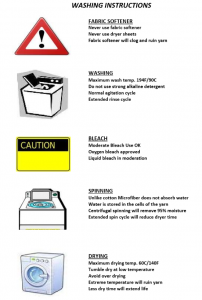
If the towel/wiper/pad becomes too dirty, it will also begin to “streak”. It is then time to wash the towel. This is easily done by just throwing the towel, or any other microfiber cleaning product, into any washing machine and laundering with any soap or detergent you prefer.
A word of caution here; experience tells me you should be careful of the additives in our detergent as they tend to build up in the microfiber, reducing its’ ability to perform as intended. The other restriction in the wash cycle is to NEVER use any type of FABRIC SOFTENER.
The towel will treat the fabric softener as if it was dirt. It will try to store the tiny particles of the softener in the towel fibers and may cause the towel to be less effective. The use of any POLISHES will result in the same issues.
Microfiber does not MOVE the dirt or dust. It actually tries to trap it, and this means a microfiber product will “fill up” periodically. This dirt and dust is released in water and soap. Soap helps release the greasy part of the build-up. If the fiber is being used with water, it must be rinsed and wrung out periodically for best performance.
Remember, the microfiber is trying to trap and remove dirt and dust, and it should not be used to mop a whole floor or clean a whole room. The skill comes with knowing when to change out or rinse out the microfiber tool.
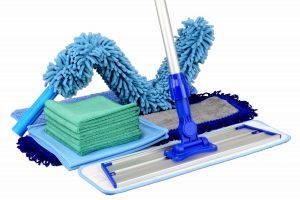
Microfiber is available in several different forms. The most common forms are the “Terry Style” and the “Suede Style.” The terry style is best suited for all general cleaning purposes, both domestic and industrial.
Suede works best in any “polishing” application, such as eye glasses, sun-glasses (except transitional A/R), all optics and lenses, CD’s, computer screens, TV screens, jewelry, coins, leather, and even as a replacement for a chamois to dry off your car.
Both of these styles can be used wet or dry, without soap or chemicals (chemicals CAN be used with microfiber, but usually they are not needed!)
Unlike ordinary cleaning towels that only move or push the dirt and dust from one point to another, microfiber actually “scrapes” the dirt or stain from the surface, and then stores the dirt particles in the towel, until it is washed.
Most of the time, it is best to use the suede towel dry, however, it will never harm the towel if you want to wet it. With both of these towel styles, when using wet, it is very important to always wring the towel as dry as possible. If a microfiber towel is dripping water, it is too wet and will leave streaks on the surface you are cleaning.
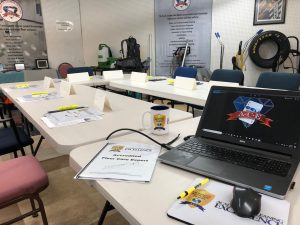
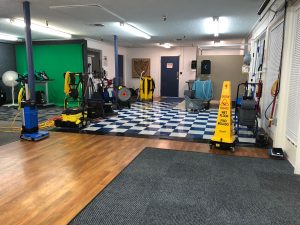
The Academy of Cleaning Excellence held another professional development class yesterday.
“How to clean, polish and refinish resilient floor surfaces.
Students reviewed with the instructor the reason we take care of
floors, and it is not for Appearance. You’ll have to come to class to learn the real reason. Everyone got a chance to operate tools and equipment and watch a demonstration of proper finish application.
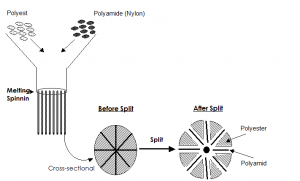
The technology was first developed commercially in Japan in the mid to late 1960’s for synthetic suede fabrics. Staple fibers were spun from two polymers, a polyester and polyamide of 0.1 denier or less.
If the microfiber is not split the cloth, pad or mop will tend not to be very effective. How many times a single strand of 1 denier microfiber is split, will make a tremendous difference in the performance of the tool.
Be advised there are 4, 8, 16 split and this will also have bearing on the initial investment as well. It is during this process the percentage blend of polyester and polyamide will show up. Always look for a processed microfiber wiper or pad to improve performance.
Now that you know a microfiber is simply a nano sized fiber, what is that nanofiber made of?
Microfiber is a man-made product combining two basic fibers, Polyester and Polyamide (a nylon by-product.)
These fibers are then “split” and formed into a blend of
80% Polyester (the scrubbing and cleaning fiber), and
20% Polyamide (the holding and quick drying fiber.)
In written form, this blend is expressed as “80/20.”
There are approximately 200,000 microfibers in one square inch of a microfiber towel. A single strand of microfiber is so small that it is almost invisible to the naked eye.
These ultra-small fibers give the material the ability to clean surfaces and remove dust and dirt without scratching. You can often detect a microfiber cloth because it clings to your skin as you rub it.
Consider the fact that one square yard of a microfiber cleaning towel, if torn apart and the fibers laid end-to-end, would reach from Miami, FL to Minneapolis, MN!
Jason Moore just graduated from the first ISSA Masters class of 2017 and has these insights to share. This class is now the ISSA/CMI Masters class and is held at the ACE Academy every month.
Click on the link below to listen to Jason and Dave
Question: What are the top SIX activities in cleaning that will have the greatest impact on safety and health?
Answer: Here is my list of the top SIX activities necessary to impact the health and safety of our public.
Train and retrain housekeepers (custodial staff) that their role is NOT cleaning for appearance sake, but for “health’s sake.” For too long we have judged the cleanliness of surfaces based on a shiny floor, smudge-free glass, spot-free carpet and a clean nice smelling restroom. The indoor environmental surfaces can be clean, but unhealthy or unsanitary. BUT, if those same surfaces are healthy and sanitary, THEY ARE CLEAN! There is a science to cleaning and disinfecting. The Environmental Services (ES) staff performs both the a.) Clinical function of removing and inactivating/killing HAI producing microbes, and, b.) The practical function of cleaning by restoring the room to order after soil removal activities are completed.
The time has come to turn cleaning professionals into Certified Environmental Services Technicians (CEST). Moreover, infection prevention will only become a reality when the CEST is properly regarded, educated and equipped. The certified technician must be: a) Well trained and coached; b) Equipped with the necessary tools to clean, sanitize and/or disinfect; c) Allotted time to do the necessary tasks; d) Provided the tools to enable scientific measurement of “clean”; e) Educated about the prevention and transmission of disease.
Train those who clean that there is a pattern for cleaning; Clean the room from top, down and from the cleanest part of the room to the dirtiest; leave the rest room for last. When cleaning the “patient zone” (the area 3′ [1 meter] around the patient’s bed, including the bed rails); use a fresh, clean cloth for the patient’s zone.
Never double dip a cleaning cloth. Set up a bucket of properly diluted disinfectant at the beginning of the shift; add 10-15 microfiber cloths to the bucket. Reach into the bucket for a clean, disinfectant-charged cloth; NEVER return (double dip) a soiled cloth into the solution bucket. The analogy I like to use is this; when you pull a disposable disinfectant wipe from a container and use it to wipe a soiled surface, do you return it to the container? No, it is disposed of. The same should be true for soiled microfiber cleaning cloths…they are put into a bag to be laundered daily.
Using a quaternary ammonium disinfectant with “retired” cotton cleaning cloths (i.e., surgical towels, terry cloth towels and washcloths) and mops is counterproductive. Unfortunately, this combination is used in most hospitals and hotels. The cotton in these retired cloths inactivates quat disinfectants by binding the active ingredients to the cotton rather than releasing them to the surface. This happens within 5 minutes of introducing cotton to the bucket of quat disinfectant. In fact, you might as well be using water after 5 minutes because the ppm of active ingredients is out of specification for EPA registration. At that point, you are using the product “in a manner inconsistent with the manufacturer’s label” and are in violation of US federal law.
Regardless of whether or not a “One-Step” disinfect (manufacturer claims surfaces do not need to be pre-cleaned) or a “Two-Step” disinfectant (must be applied to pre-cleaned surfaces) is being used, the surface SHOULD be cleaned with a general purpose cleaner and a high denier microfiber cloth for soil removal and followed by the disinfectant of choice. The AOAC testing that is done on disinfectants before submitting them to the US EPA for registration is “in the presence of 5% blood serum.” If surface soil is greater than 5%, the disinfectant is most likely over challenged (ineffective due to the soil load). For a surface to have greater than a 5% soil load, the soil most likely is NOT VISIBLE. If 90-95% of the soil (and micro-soil) can be removed with a general-purpose cleaner and superior microfiber cloth, most of the food and moisture necessary for microorganisms to survive on a surface are removed. Then, the disinfectant that is applied has a much better chance of killing the remaining microorganisms.
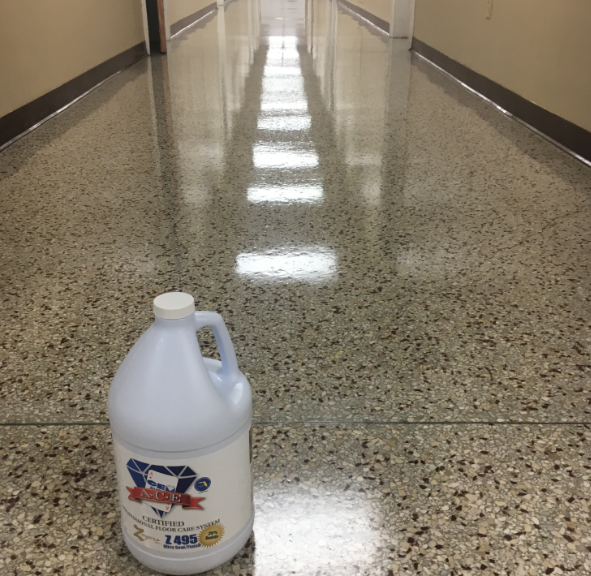
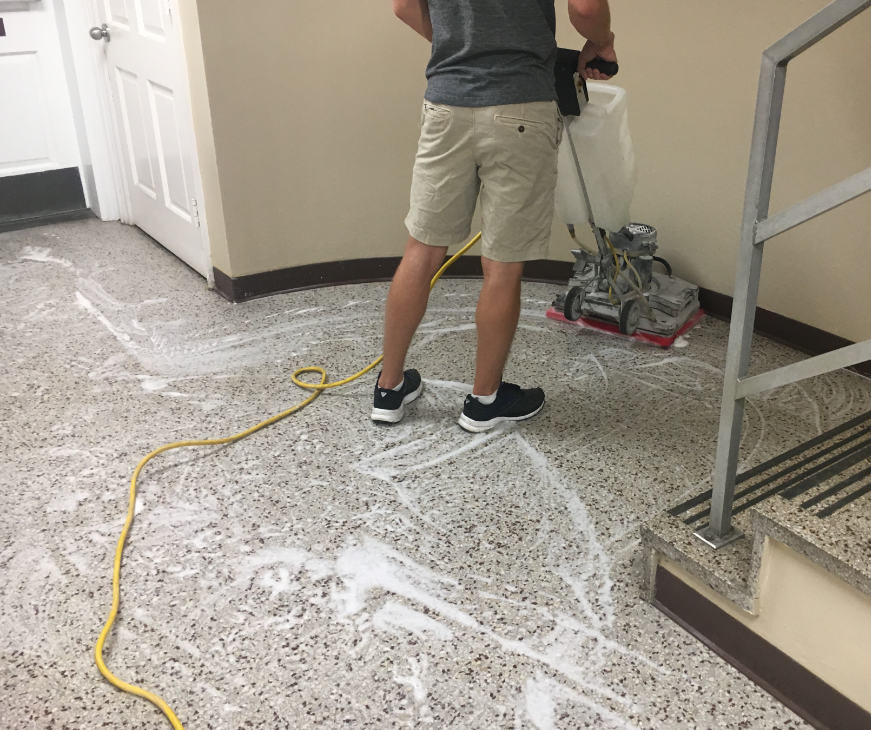
Richard from First Baptist Church of Winter Park, FL attended a floor care class earlier this year. Last night, the crew was challenged with their first real test and the Academy was there to walk them through the steps on how to top strip and refinish their 5,000 sq. ft. of terrazzo floor.
A 14″x 20″ oscillating scrubber with red cushion pad, a Maroon floor pad and water was used to top strip. The removed finish was picked up with an auto-scrubber, red pad and water. Several passes were made to rinse the floor. A microfiber flat mop was used to detail the edges and the terrazzo was ready for finish.
Two coats of Z-495 were applied. Richard & crew did a bang up job for their first time. Even laying finish didn’t seem to slow them down. After a few days, they will certainly be ACE Experts.


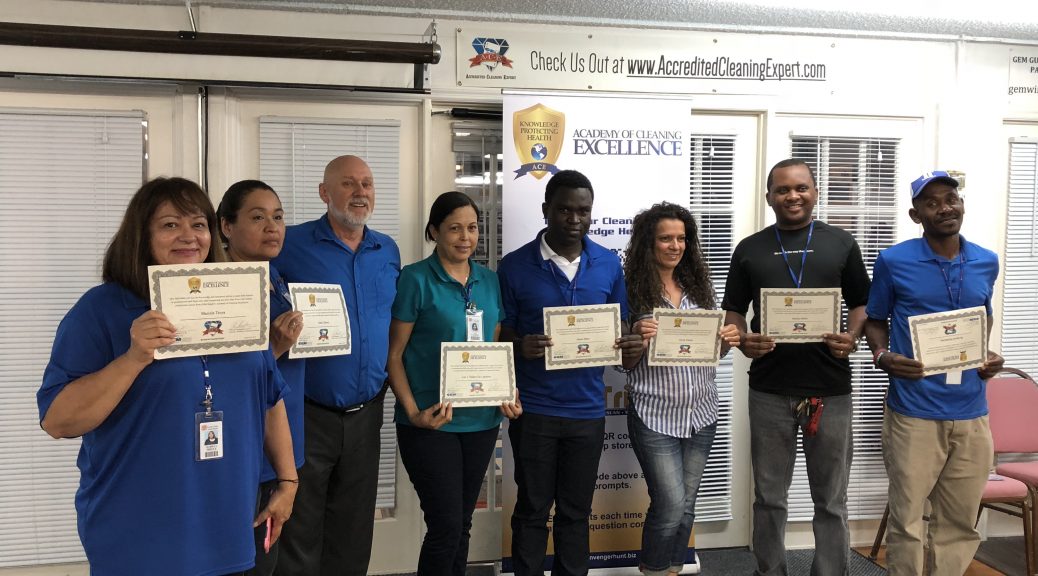
 The Academy of Cleaning Excellence held another professional development class yesterday.
 the initial investment as well. It is during this process the percentage blend of polyester and polyamide will show up. Always look for a processed microfiber wiper or pad to improve performance.