Category Archives: Downright Interesting Stuff

Six Facility Spring Cleaning Tips You Can Use

Six Facility Spring Cleaning Tips You Can Use

Springtime means storm season for most areas of the country. Spring storms can create facility challenges, such as entry-way cleanliness and safety issues, water damage, and more. To help you with these seasonal weather-related facility challenges, we’ve developed a few tips for facility managers and cleaning contractors to help ensure that your facility is clean and safe for building occupants.

1. Freshen up facility appearance: To maintain the building and to improve the appearance of your facility overall, take time to address small maintenance issues such as changing light bulbs, touching-up paint, and replacing entry-way matting.

2. Entryway Safety: Springtime brings storms and wet weather conditions which can create safety hazards for building occupants. Be sure to invest in new matting systems or clean existing matting at all building entrances and exits. Spring is also a good time to perform floor care equipment maintenance, or if appropriate, invest in new floor care equipment that will address spring cleaning challenges. For example, wet-dry vacuums or air-movers are important to keep entryways safe and dry. Additionally, make sure your facility has enough “caution wet-floor” signs to use at entrances and exits during rain and storms to minimize slips and falls.

3. Focus on flooring: Winter weather can really take a toll on your facility’s floors. Restore your hard floors and grouted tile in the spring by cleaning them with cylindrical brush floor scrubbers. When it comes to restoring carpeting, deep-clean carpets with moisture-controlled carpet extractors to bring the fabric back to its original beauty. This deep-cleaning process also helps to extend the longevity of your facility’s flooring assets, and can delay expensive replacement costs.

4. Deep-Clean Restrooms: The Spring is the perfect time to consider implementing a no-touch deep cleaning system for restrooms that effectively removes built-up soils by sanitizing all restroom surfaces and fixtures.

5. Maintain and Clean air conditioning units: To lower your energy bills and ensure the best indoor air quality (IAQ) for building occupants, facility managers should complete a comprehensive A/C coil cleaning service. Completing regular A/C coil cleaning removes dirt, grime and built-up sludge from A/C units which can improve IAQ, lower energy bills and extend the life of air conditioning units.

6. Begin Using Environmentally-friendly Products and Cleaning Practices: According to a recent Harris Interactive survey, 84% of U.S. adults prefer to do business with a company that uses environmentally-friendly products and practices. Be sure to select products that meet the requirements of the EPA’s Designed for the Environment Program (DfE) for safer chemistry, or Green Seal certified products. What’s more, businesses can implement green cleaning methods such as the use of low-moisture dilution control chemical dispensers on hard-floor automatic-scrubbers, moisture- controlled carpet extractors that reduce moisture and improve carpet drying-times, and switch to reusable mops or surface wipes to limit environmental impact.

Tips provided by CFR Corp.

Loading

Exclusive Toilet ‘Club’ To Open In New York City

Exclusive Toilet ‘Club’ To Open In New York City

The days of having to stop-and-go in a seedy, smelly or unsightly public restroom may soon be a thing of the past. The European Cleaning Journal reports that a new facility — really, an amped up version of an Interstate rest area — will open in New York City, by summer.

The company, POSH Stow and Go, is seeking a limited number of ‘members’ to sign up to use its clean, soundproofed restrooms when visiting the city for shopping and sightseeing. Among the facility’s amenitities include touch-free taps, “frequently-cleaned” baby changing tables and motion-sensored toilets.

According to company founder, Wayne Parks: “I’m a germaphobe and I don’t like dirty bathrooms, but these are great because they are cleaned after every use. POSH Stow and Go will also be a resting place for visitors who don’t have homes or offices in Manhattan. And it’s a place to drop something off if you’re in a jam.”

The first facility opens in June in Midtown Manhattan between Grand Central and Penn stations. Besides the restrooms, the POSH Stow and Go outlet will also offer storage lockers, showers, laundry machines and a lounge area with wood floors and couches with phone-charging stations.

Facility “members” will pay about a $15 annual fee plus $24 for three days’ use.

If the Midtown location catches on this summer, the company will open another facility in lower Manhattan at a later date, the journal reports.

article from CleanLink.com

Loading

ISSA TV, Put the Pro in Professionalism

Put the Pro in Professionalism With Anthony Trombetta

Do you know how many steps someone will take to reach a garbage can? The cleaning professionals at Disney know, and they use this kind of knowledge to makes themselves a valuable part of the branding strategy. In this week’s ISSA TV, Educational Quick Clip, Anthony Trombetta explains how you can use better training—and top-notch professionalism—to make cleaning a walk in the park, just like Disney…..Watch it Here

Loading

“What Can I Do” Sustainability-Chemical Choices and Disposal, by American Cleaning Institute

wcidotyp

A step-by-step guide to buying, using and disposing of household cleaning products – the environmentally smart way

00wcidoIt’s all about choices… and doing what’s best for the environment — a goal that’s important for all of us! One area where each of us can make a positive contribution is in the way we purchase, use and dispose of cleaning products. And it all boils down to one simple question…

“How can I do the right thing in my own home, every day?”

The following steps are designed to help you make the best decisions about cleaning products for your family, your community and the environment.

01wcido  1. Before you buy…

  • Think about the cleaning job at hand.
  • Read product labels carefully.
  • Choose the product that is best for your job.
  • Buy only what you can use.
02wcido 2. Before you use…

  • Read the label and follow directions for proper use.
  • Follow all safety precautions.
  • Use the recommended amount. More is not necessarily better!
03wcido 3. After you use…

  • Read the label and follow directions for proper storage.
  • Keep lid tightly closed. If there is a child resistant closure, use it!
  • Keep product in original container with readable labels.
  • Share any product you can’t use with a friend or neighbor.
04wcido 4. If you must dispose of a product…

Follow label directions if provided. If there are no directions:

  • Think about how you use the product. If it mixes with water it’s water-soluble. Most liquid, gel and powder water-soluble household cleaning products can be disposed of down the drain with running water – just like when you use them.
  • Most solid products (soap scouring pads, sticks, towelettes, etc.) can be placed in the trash.For other products (such as oven cleaners, crystal drain openers and furniture polishes) call the manufacturer’s toll-free number (or write to them) for disposal recommendations, or check with your local waste disposal facility.
05wcido 5. When you dispose of the containers…

  • Empty any unused product (see #4).
  • Check with your Community Recycling Center to see what type of plastic, paperboard and metal containers they accept.
  • Refer to local guidelines for recycling plastics, paperboard and aerosol cans (steel and/or aluminum).


Proper Disposal of Water-Soluble Household Cleaning Products


06wcido  

07wcido

In the Trash … (aerosols, crystals, disks, pads, pastes, sheets, sticks, towelettes)

  • Laundry Products
  • Fabric Softeners
  • Stain Removers
  • Dishwashing Products
  • Rinse Agents
  • Household Cleaners
  • All-Purpose Cleaners
  • Bathroom Cleaners/Disinfectants
  • Carpet/Upholstery Cleaners
  • Drain Openers
  • Furniture Cleaners
  • Glass Cleaners
  • Oven Cleaners
  • Toilet Bowl Cleaners

Wrap containers in paper before disposing in the trash.


Down the Drain … (liquids, powders*, gels)

  • Laundry Products
  • Bleaches
  • Detergents
  • Fabric Softeners
  • Presoaks, Prewashes
  • Water Softeners
  • Dishwashing Products
  • Automatic and Hand Dishwashing Detergents
  • Film and Spot Removers
  • Rinse Agents
  • Household Cleaners
  • All-purpose Cleaners/Cleansers
  • Ammonia
  • Baking Soda
  • Borax
  • Carpet Cleaners
  • Disinfectant Cleaners
  • Drain Openers
  • Floor/Furniture Cleaners
  • Glass Cleaners
  • Multi-Surface Cleaners
  • Toilet Bowl Cleaners
  • Tub/Tile/Sink Cleaners
  • Personal Care Products
  • Hand/Body Soaps

When disposing of cleaning products:

  • Flush with water
  • Do not mix products

* Dispose of powders in very small quantities at a time. This will help keep them from forming lumps in the drain pipe.


Did You Know?

Your community may spend a lot of money when disposing of household hazardous waste (HHW). In general, HHW costs 10-15 times more to dispose of than non-hazardous municipal waste! If you’re disposing of non-hazardous materials in this way, it may be affecting your tax dollars.

Water-soluble household cleaning products (HCP) usually do not fall into the HHW category because they go safely down the drain or in the trash. So, think before you treat them as HHW — you’ll be saving your community money!

Start Out on the Right Foot…

Cutting down on trash at the source.

We all want to conserve resources and keep waste to a minimum. It’s called waste reduction – cutting down on excess products and their packages at the source.

The soap and detergent industry has been working hard to conserve resources and reduce waste. We’ve developed such innovations as concentrated products in smaller packages … combination products (providing two functions in one product) … refillable containers … and we’re also using recycled materials to make new containers. In fact the industry has become one of the biggest purchasers of recycled plastics, giving new life to the plastics you recycle!

Here’s where you come in. By buying concentrated products, refills or containers made from recycled materials – and by recycling your used containers – you’re keeping excess trash out of landfills. It’s partnerships like these that will provide the long term solutions. And, by working together, we’ll all be doing what’s best for our environment.
08wcido

Follow the Steps to Smart Use and Disposal

“Thinking Green” is a daily journey! By making informed decisions before, during and after product use, you’re on your way to doing the right thing for yourself and your community. And remember, the key to smart use and disposal is reading the label! It’s the single most important thing you can do to make the right decisions.

Thank you American Cleaning Institute!


Loading

When Humans Need a Nudge Toward Rationality-By JEFF SOMMER

When Humans Need a Nudge Toward Rationality-By JEFF SOMMER

Published: February 7, 2009
The New York Times
THE flies in the men’s-room urinals of the Amsterdam airport have been enshrined in the academic literature on economics and psychology. The flies — images of flies, actually — were etched in the porcelain near the urinal drains in an experiment in human behavior.

Images of flies in airport urinals have taught a lesson about human behavior, says Richard Thaler, the behavioral economist.  After the flies were added, “spillage” on the men’s-room floor fell by 80 percent. “Men evidently like to aim at targets,” said Richard Thaler of the University of Chicago, an irreverent pioneer in the increasingly influential field of behavioral economics.

Mr. Thaler says the flies are his favorite example of a “nudge” — a harmless bit of engineering that manages to “attract people’s attention and alter their behavior in a positive way, without actually requiring anyone to do anything at all.” What’s more, he said, “The flies are fun.”  (Click Here to Read More)

Loading

Return of the Bed Bugs!!! by Rob Cloyd, Gem Supply Company

Return of the Bed Bugs

Bed Bugs (called such because they are commonly found in the bed or bed room area) a parasitic insect that feeds exclusively on blood like little Vampires, were mostly eradicated in the developed world in the early 1940s have increased in numbers since 1995.  With the change in available use pesticides, Bed Bugs are now harder than ever to control, let alone eradicate. What was once a pest problem under control in the U.S. is now back as an epidemic.

A number of adverse health effects can result from bed bug bites, including skin rashes, psychological effects, and allergic symptoms. Bed Bugs feed on humans only when other sources of prey are unavailable.  They are attracted to their hosts primarily by carbon dioxide, and secondarily by warmth.  Bites are not usually noticed at the time of attack, they develop slowly to itchy welts that can take weeks to go away. Bed Bugs prefer exposed skin of a sleeping individual with the neck, jaw line and arms being easy target places to feed.

There are six different stages to the Bed Bug life, (five immature nymph stages and a final mature adult stage).They shed their skins through each stage which is called molting, leaving behind their clear outer shells (called an exoskeleton). Bed bugs molt six times before becoming reproducing adults and need a blood meal to complete each molt. Each stage lasts approximately a week, depending on temperature and the availability of food, and the complete life cycle can be completed in as little as two months. Females can lay between 200 and 500 eggs in their life span. Adult Bed Bugs will try to feed every five to ten days, but can live as long as a year without feeding if the conditions are right and normally can survive for four to five months without food.  Younger instar Bed Bugs cannot survive as long, and newly hatched first instar Bed Bugs can survive for weeks without taking a blood meal.

A Bed Bug infestation is not necessary a sign of poor sanitation or cleaning practices and are spread by the activity of people on the move. They can and do hitch rides in boxes, suit cases, backpacks and on our clothing.

The first step to attacking a Bed Bug infestation is a thorough inspection.

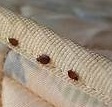
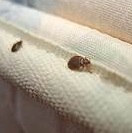
BB3 BB1To be successful in ridding the problem, you must identify the problem and the area of infestation. So it is paramount to know how to identify bed bugs.  Adults can easily be seen with the naked eye. Adult bed bugs are reddish brown in color, wingless, and are about the size of an apple seed. Immature bed bugs can also be seen with the naked eye although smaller than adults, and translucent whitish-yellow in color. The most difficult life stage to see is the first instar nymph. This is the youngest life stage that hatches out of the egg. These nymphs are so small that they are difficult to see unless they are moving or have recently fed (bright red when full of blood). Bed bug eggs are also tiny, about the size of the head of a pin. The eggs are pearl/white in color.

You will need a few simple tools to complete your inspection, first of all a strong flashlight is a must; other tools could include a screw driver set, wrench set or pliers, and a hammer. Some furniture disassembly may be required.

Start the inspection by carefully removing all bed linens and them removing the mattress standing it up to inspect each tuff and pleat, doing the same with the Box Springs. Next inspect the bed frame by disassembling as much as possible, checking every point of connection, cracks and hiding places, and then the headboard in the same manner. This area is where you are most likely to find evidence and activity.  Next you will need to inspect the night stands, dressers and chests, removing all stored items including the drawers. Inspect all points inside and out. Then move to the chairs, couches and any other furniture items.

Bed bugs are elusive and usually nocturnal (peak activity usually occurs between 10:00 p.m. – 6:00 a.m.), which can make their detection difficult. They often hide in cracks and crevices, laying eggs by the hundreds in fabric seams. Signs to look for, include fecal spots (small dark sand-like droppings that occur in patches around and especially in nesting areas), blood smears on sheets and bedding, the presence molted exoskeletons and the little Brownish – Reddish insect itself.  Although bed bugs can be found one at a time, they tend to congregate when the infestation increases. When done feeding a bed bug will relocate to a place close to a host, commonly in or near beds or couches in clusters which called a harborage area, ready to return for future feedings. These places can vary greatly and include bedding and bed area, luggage, furniture, electrical sockets, electronics, baseboards, picture frames and the list can go on and on. You must look everywhere in the room.

Eradication of bed bugs frequently requires a combination of pesticide and non-pesticide approaches.  Pesticides must be applied according to the label and be labeled for the use against Bed Bugs.  Non-pesticide approaches also known as Mechanical approaches, such as Vacuuming, Freeze Treatment, Steam Treatment, Heat Treatment, Mattresses Wrapping and Laundering, can aid in the control of Bed Bugs. All of that said, completely controlling a Bed Bug infestation can take a number of full treatments using both pesticide and mechanical approaches.

The treatment methods for Bed Bugs include:

  • Pesticide Application, with an approved labeled pesticide, following the label directions; crack and clevis treatment and or dusting of all voids, furniture and contents in the area where harborage can occur.
  • Fumigation, Fumigation is the most labor intensive and the most expensive although the most effective. Requires a Fumigation Specialist. Items such as plants, open food and perishables, medicine, some special metals, pets, etc. must be removed before treatment begins. Fumigation of specific items can also be done in a container, such as a fumigation trailer.
  • Heat Treatment, to bring the area up to ranges above 140 degrees. This method has some risks of fire, and can break down the properties of some glues and resins. Heat may not always penetrate all areas of furniture. Items such as electronics, plants, medicine, CDs/DVDs, perishables, art, pets, etc. must be removed before treatment begins.
  • Freeze Treatment, Freezing with carbon dioxide snow (dry ice) is a safe and non-toxic method that penetrates deep into cracks and crevices killing bed bugs, eggs and larvae. Freezing is completely dry and can be used on furnishings, electronics, art, etc. You should disassemble the furniture as much as possible.
  • Steam Treatment, Steam is of course heated water which can be very effective if applied correctly, focus on the carpet, seams of bed mattresses and box springs, drapes along with other furniture. You should disassemble the furniture as much as possible.
  • Vacuuming, Vacuuming can be very effective; because you can remove what you can see, but keep in mind that vacuuming alone will not solve the problem. Vacuuming to include; the carpets, drapes, every piece of the furniture at all points of fabric, cracks and joints. You should disassemble the furniture as much as possible.
  • Mattresses Wrapping, Covering the Box Springs and Mattress with a Bed Bug Cover, the better covers will have a zipper that can be locked and secured. Any bugs missed or hiding will be contained to die and new activity can not penetrate.
  • Laundering, Place all bed linings and clothing from the infested area into a plastic bag and tie it shut, take them directly to the washer, they must be washed in Hot Water and Dried on the highest setting.

So get that Vacuum and Steamer out and don’t give up, and remember to discard the Vacuum bag after each use.

And by the way, boric acid is not effective against bed bugs, because bed bugs do not groom themselves as other insects do.

Rob Cloyd – Twelve Years’ Experience as a Pest Control Operator and Gem Supply’s Director of Business Development/Customer Service.

Loading

Hot Spots for Germs in the Office, CleaningInstitute.org

Computer Cleaning

Hotspots for germs in the office

Think about all the “public” surfaces you touch on your way to work – railings, door handles, coins and tokens, cash machines, elevator buttons and more. Then, when you get to your destination, washing your hands probably isn’t the first thing you do. Instead, you probably grab a cup of coffee and turn on your computer. If you power up before you clean up, all the germs and bacteria that commuted with you are transferred from your hands to your workstation. Ugh! And then, if someone else sits down at your computer, you’ve got all the germs that tagged along with them, too.

Before you begin, remember the two golden rules of computer cleaning:

  • Be sure the computer is off before you clean any part of it – keyboard, monitor screen, mouse, printer or housings.
  • Never spray cleaner directly onto any part of the computer. Spray it onto a cloth, and then gently wipe.

Keyboard: Clean the keys with a cleaning wipe or a cloth sprayed with an all-purpose cleaner. Make this the first thing you do every morning before you turn on the computer. To remove the dirt, dust and other debris that gets caught between the keys, turn it upside down and shake gently to dislodge the particles. An air duster is also a great aid in removing all these bits and pieces that get lodged inside the keyboard.

Mouse: It’s also a good idea to clean the mouse before the start of the workday. Use a cleaning wipe or a cloth sprayed with an all-purpose cleaner.

Monitor: Use a microfiber cloth, either dry or dampened with clean water, or a product specially formulated for computer screens. If you use anything else, you run the risk of damaging the screen. Clean the monitor several times a week, as a dirty monitor can cause eyestrain.

Surrounding surfaces (including computer housings and desktops): Since there are probably coffee and food stains lurking amidst the dust, use an all-purpose cleaner with a disinfectant.

Printer: Consider how often you push the button on the printer and how seldom you think about cleaning it!

Telephone: Even if you’re the only one using it, it’s still transmission central for germs and bacteria that cause ear, nose and eye infections. Clean it daily using a hard-surface disinfectant cleaner or a wipe.

Loading

Floor Care Equipment That Contributes to LEED Certification by Kassandra Kania

Floor Care Equipment That Contributes To LEED Certification

By Kassandra Kania 

As the sustainability movement continues to flourish, more custodial managers are demanding environmentally friendly products to satisfy in-house green initiatives, as well as earn credits toward LEED certification for property owners.

Although there are no certifications for floor care equipment per se, by adhering to U.S. Green Building Council (USGBC) guidelines when buying or using floor care equipment, custodial departments can help businesses earn points toward LEED certification.

According to media associate Jacob Kriss, the USGBC awards up to one point toward LEED for Existing Buildings: Operations & Maintenance (LEED-EBOM) for projects that implement a program for the use of janitorial equipment that reduces building contaminants and minimizes environmental impact (see “Indoor Environmental Quality c3.4: Green cleaning-sustainable cleaning equipment” for excerpted requirements pertaining to floor care equipment).

For existing powered cleaning equipment, 20 percent must meet the criteria set forth in this credit by cost or unit count, whereas newly purchased equipment must meet 100 percent of the credit requirements. Under the new version of the rating system, set to launch in Fall 2013, the cleaning equipment credit will require 40 percent of powered equipment to meet certain criteria, while equipment that does not meet the criteria must be phased out.

“Everything in LEED is good for the environment and the organization, and makes sense to do,” notes Michael Arny, president of Leonardo Academy in Madison, Wis. “If people want to operate their buildings in a greener way, the more of the LEED program they can follow, including the cleaning component, the further they are down the path to making their building more sustainable. And they also position themselves to move forward with LEED certification more easily, if and when they decide to do that.”

According to Bill Griffin, president of Cleaning Consultants Services Inc. in Seattle, Wash., the growing interest in sustainable flooring equipment is being driven in part by LEED.

“The evolution in equipment is in the response to demand from customers wanting to be more sustainable,” he says. “LEED is driving some of this, and the demographic of people running these buildings is also driving this to some degree. There’s a younger crowd coming in, and they’re more aware and have a higher expectation regarding green.”

Although the industry is moving toward greener flooring equipment, Stephen Ashkin, president of The Ashkin Group in Bloomington, Ind., urges cleaning departments to keep in mind that this is merely one part of a comprehensive green cleaning program.

“Don’t lose sight of the fact that this is one important element in an entire system that ultimately will meet the intent of the LEED credits,” he says. “And that intent is to create safe, healthy, productive environments while minimizing negative impacts on the environment.”

Reducing Water Usage With Floor Equipment

Reducing water, energy and chemical usage are important prerequisites for achieving credits toward LEED certification. Likewise, when implementing a green program and reassessing floor care equipment, cleaning departments should look for opportunities to reduce water and energy consumption.

“There are greener and more sustainable floor machines on the market today that use less water or use eco or hybrid water instead of plain water and chemicals,” says Griffin. “There are also ultra high dilution products where you put a cartridge in the machine and it automatically dilutes the chemical.”

To reduce power consumption, managers should look for equipment with Energy Star ratings, or battery-powered equipment that uses environmentally preferable gel batteries.

In addition to reducing water, power, and chemical usage, managers should look for floor equipment that reduces noise levels. Griffin recommends equipment that operates below the 65-decibel rating. Departments also need to consider how their equipment fits into their green protocol. For example, the decibel level of the machine becomes more significant if they are cleaning during the day when the building is occupied.

“Environmentally friendly equipment isn’t just about protecting the environment, but also the employees using the equipment,” says Stan Hulin, president and CEO of Future Floor Technology Inc. in Gladstone, Ore. As such, manufacturers are paying more attention to machine ergonomics by designing equipment with operator comfort and safety in mind.

KASSANDRA KANIA is a freelance writer based in Charlotte, N.C.

Republished from Cleanlink.com


Loading

Your Mobile Phone is Dirtier than You Think! by Patrick Boshell, DebGroup.

Your Mobile Phone Is Dirtier Than You Think

Posted by Patrick Boshell on Wed, Jul 17, 2013
“It’s a well-known fact that cell phones are dirty objects, but just how unclean are they? Fun fact: each square inch of your cell phone contains roughly 25,000 germs, making it one of the filthiest things you come in contact with on a daily basis. That’s something to think about the next time you press your face to your phone.

Ever wonder what objects are actually cleaner than your phone? Surprisingly, toilet seats make the list because they’re usually sanitized often. Watch the video to see how an average cell phone’s bacterial count stacks up compared to other household items,” as reported by Mashables.

Menshealth recently interviewed Dr. Charles Gerba, a professor of microbiology at the University of Arizona who says this is not surprising.   “Nobody ever cleans or disinfects their phone, so the germs and bacteria just keep building up,” he explains. What types of germs? E. coli, as well as influenza and MRSA, a germ that causes rashes and skin infections, Gerba adds.

Bacteria on your phone

As we use our phones frequently it remains warm, creating the ideal breeding ground for bacteria.   “With the advent of touch-screen phones, the same part of the phone you touch with your fingertips is pressed right up against your face and mouth, upping your chances of infection,” Gerba adds.

A recent article explored some of those terrifying germs and summarized details from a study involving 200 phones as published in the “Annals of Clinical Microbiology and Antimicrobials.”  

 “The researchers found that 94.5 percent of the phones were contaminated with some kind of bacteria, many of which were resistant to multiple antibiotics. By also testing the participants’ hands, the researchers were able to show that a significant number of germs were transferred from their hands to their phones, and vice versa. In fact, about 30 percent of the bacteria on the phones ended up on the owner’s hands.

Much of the disease-causing bacteria they found are transferred from person to person through touch, which means that once this bacteria is on your hands, you only have to then touch your eyes or nose for the bacteria to find an easy route into your body. This is especially frightening when you consider how often your phone hangs out only millimeters away from your face.

The wide spread use of mobile phones by healthcare workers has become a question of concern.  A recent study study on mobile phones and Nosocomial infections reported, “HCWs’ mobile phones may serve as reservoirs for microorganisms that could facilitate the transmission of bacterial isolates from one patient to another in different hospital wards.  Whereas strict attention is paid to changing clothes, removing jewelry, undertaking hand hygiene measures (WHO 5 Moments), and storing personal objects in changing rooms to reduce the transfer of microorganisms from the external clinical environment into the operating environment, most expensive mobile phones often accompany staff into the operating environment as currently no local policy restricting the use of mobile phones in clinically sensitive areas is in place. This lack of attention may be indicative of little awareness about potential risks posed by mobile phone microbial contamination and their role as vehicle for transmission of infections.”

Mobile Phones in Healthcare

The report went on to recommend, “Restriction of mobile phone use in clinically sensitive areas, such as operating environment and ICU as a start point, is recommended. Moreover, screening of HCWs’ mobile phones inside the hospital should be done while doing environmental screening.”  This would be supported by, “A major educational campaign to raise awareness” and recommendation that “mobile phones could be produced with protective material against contamination.”

A new Practice Guideline was issued by the Community and Hospital Infection Control Association (CHICA-Canada) to address the issues of electronic devices in healthcare settings. Recommendations coming out of that guideline include the following:

  1. Hand hygiene should be performed between patient contact and before and after accessing a device.
  2. Manufacturer’s guidelines for use, cleaning/disinfection and maintenance should be reviewed to ensure these guidelines meet the standards for cleaning and low-level disinfection that are necessary for exposure to Multi-Drug-Resistant Organisms.
  3. Items that cannot be adequately cleaned should not be used, or should be designated as “clean” and not be accessed in patient rooms or be touched by patients.
  4. If an item cannot be cleaned with a hospital-grade disinfectant and is necessary for patient care, a risk assessment should be done with infection prevention and control to determine the best approach to mitigate the risk of transmission of microorganisms.
  5. All touch-surfaces of IT devices used at, or near, point-of-care must be cleaned and disinfected with a hospital-grade disinfectant if used or touched during the encounter with the patient.
  6. The surface of telephone components, pagers and computer ‘mice’ should be cleaned in a manner that prevents damage to internal systems from excessive fluid.
  7. If an item cannot be adequately cleaned and will be accessed in a patient room or touched by patients, it requires a cleanable cover.
  8. The user/owner of the device is responsible for routine cleaning and disinfection of the device and that  responsibility must be clearly communicated.

Loading

What Customer Service Should Be. By Erica Cruz Lopez

What Customer Service Should Be. By Erica Cruz Lopez

We, as Customer Service/Passenger service representatives sometime forget why our customer mean so much to both our industry, company and image.

I would like to share this short story about a well-trained, well-mannered and professional Customer service Representative, my Father. I sometimes go to my father’s place of employment to say hello. What I witness every time I am there inspires me to be both a better person and an even better Customer Service Representative.

The minute a customer walks into my father’s shop, they are greeted with a smile that lights up the room, this immediately let’s every person know that they will be greeted with warmth and personalization. These customers respond to my father with handshakes, warm hugs and sometimes kisses on the cheeks just because he smiled. All attention from my father is diverted solely to the customer. Coffee is offered, asking about family and health is exchanged and the biggest thing: Laughter, like they knew each other for years and some of them do.

My father’s customers always have a personal story to tell him, being a family man my dad can relate to almost all of them. My Dad always said that the company he works for is “The Barber Shop of the Cleaning Industry” cause as customers come to buy, they leave with a little extra and a smile.  His attention to their needs and the knowledge of every product he sells make them come back for more.

Step by step, ounce by ounce, my dad assures them about the product they are buying, the best equipment to use, etc. And with that a trust is forged. Some customers don’t even care what the cost is, because my dad knows and made the customer know they are investing well.

I have seen my dad go to every facility this company opened, sending him to either train or help train their customers. The company he works for cares that the customer comes first and everything else is second, which is a lesson we can all take, a lesson I have also learned.

Customers are the bread and butter of any company, they pay our salary, and keep our place of employment running. My father also always said that a good working team can accomplish the most difficult of tasks and best serve our customers better than any automated “press one” machine or phone.

Customers are people who need and want the attention of the business they patronize, they want assurances of our product, the courtesy of their time and the presence of a Customer Service rep with knowledge of product and mostly humility.

Thank you!


Loading